


The arcane world of the energy market has its own language where terms such as crack spreads, spark spreads and time spreads are all part of the vernacular. I was intrigued to see the first of these mentioned in the Bank of England’s minutes of last week’s Monetary Policy Committee and curious to know why and how this might affect UK interest rates. As many readers will know, it isn't just the oil price that drives the price at the pump, but also the margin earned by refiners turning that oil into petrol and diesel. A wider crack spread means refined fuel is scarce relative to crude, adding to the pump price on top of the cost of the oil itself. Crucially, a squeeze in refining capacity takes longer to clear than a shortage of oil.
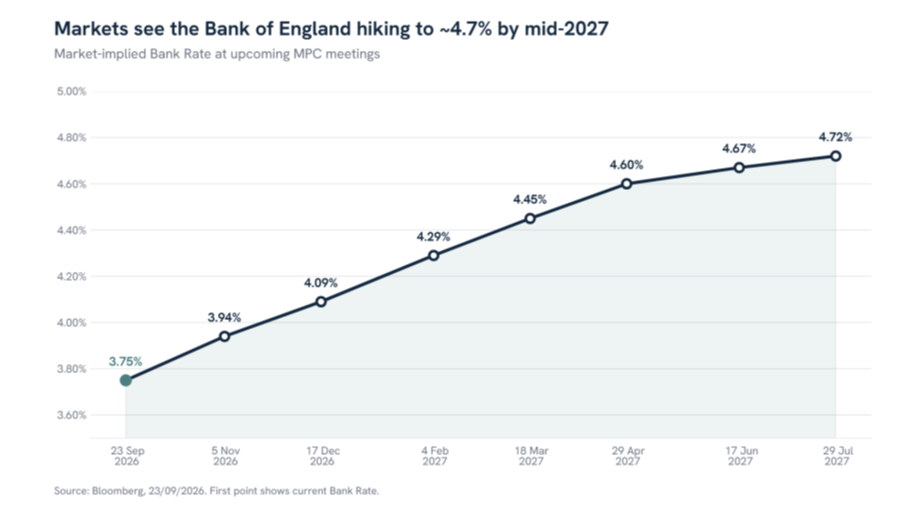
Central banks tend to look through one-off energy price spikes. What clearly concerns our Monetary Policy Committee is that this squeeze lasts long enough to feed into wages and wider prices and the minutes show that the Committee doesn't intend to wait too long for evidence of these before acting. It's only one piece of an obviously multi-dimensional puzzle, but as the graph above shows, the market is now pricing in around four quarter-point rises in Bank Rate by the middle of next year.
As I discussed in a post earlier this year, I continue to question whether monetary policy is the best tool to respond to the myriad economic challenges we face. The MPC’s minutes show that of the 1.1% overshoot in inflation, 0.7% is attributable to increases in energy prices, mainly prices at the petrol pump. Interest rate hikes won’t add anything to refining capacity but will instead hit those sensitive to interest rates hardest – those with mortgages and other loans. UK growth has not been stellar over recent years with the Bank of England unable to cut rates further in the face of ongoing inflation pressures and there’s a risk now that the Bank sacrifices the real economy on the altar of the market’s interest rate expectations. These expectations are already flowing into mortgage rates now back at levels last seen in October 2023. This won’t help a struggling residential market burdened by low transaction volumes and high levels of inventory - they say there is a housing shortage, but there’s plenty out there to buy.
The OECD’s Interim Economic Outlook report published on Wednesday suggested that the UK’s Bank Rate is already high enough to contain inflation with limited risks of second-round effects from energy costs. Personally, I’d prefer our government to assume some of the responsibility here and to take tighter control of its own spending which would ease pressure on demand and on gilt markets. This would then give the Bank room to hold rather than hike and help to bring down the UK's cost of borrowing and even possibly to get certain sectors such as housebuilding moving. Perhaps though I’d be better off spending my time figuring out what spark and time spreads are instead…